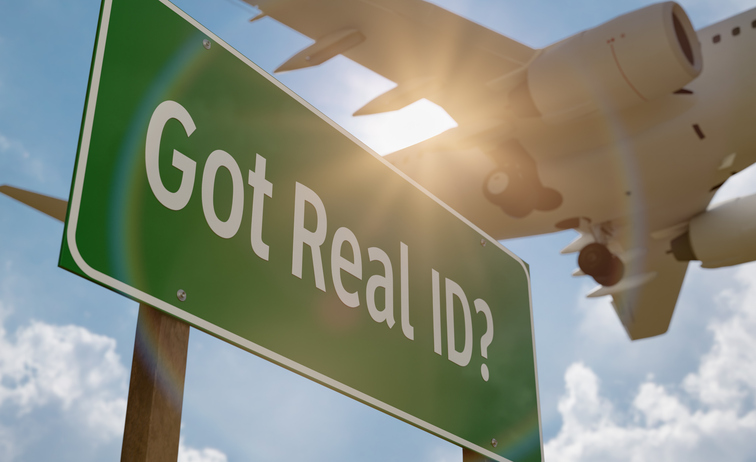
Ready to fly… or open a bank account or apply for a job?
While in a security line at New York’s LaGuardia Airport recently, I overheard a TSA agent repeating to several passengers: “It’s alright. You’ve got time.” These travelers do not yet have a “REAL ID,” the federally-secure version of a state driver’s license.
Originally signed into law in 2005 in response to the 9-11 terrorist attacks, the REAL ID requirement was delayed several times before the stated deadline of May 7, 2025.
U.S. citizens may use a passport instead of the REAL ID. But even if they don’t have that, they still can fly domestically with a standard license, at least for a while. Procedures dictate that TSA agents may soon take such passengers aside for additional questioning and to collect a fine. Facial comparison technology further identifies travelers as they pass through TSA security.
Some U.S. airports now accept a digital ID for domestic flights. Passengers may use Apple Wallet, Google Wallet, Samsung Wallet, or a state-issued app for REAL ID-compliant credentials. Airports in more than 20 states accept these mobile IDs or driver’s licenses (mIDs or mDLs) at security checkpoints.
Around the world, national digital IDs are becoming more common. Greece just launched its Personal Citizen Number (PCN) in 2025, a digital ID generated for foreign residents as well as Greek citizens. This ID verifies identity, contains an individual’s tax identification number, and enables secure public transactions. Greece even offers an optional Kids Wallet which is linked to a parent’s ID and allows online consent controls up to age 15.
Greece’s PCN aligns with the broader European Union Digital Identity wallet. This ID is a personal digital wallet for citizens, residents, and businesses around the EU, streamlining verification, documentation, and processes while protecting data privacy. Each EU member country will make its own EUDI wallet available to its citizens by the end of the year.
Digital ID programs vary in scope, maturity, and purpose. Some use verification merely as a key to engage in government transactions. Others serve to authenticate one’s identity as well as permit passage at airports and border crossings, facilitate documentation sharing for business or financial purposes, access health care, and guarantee document integrity.
Estonia was an early adopter, launching its digital e-ID more than 20 years ago. Singapore’s Singpass has also been around since 2003. In addition to Greece’s PCN, other digital IDs introduced more recently include Costa Rica’s Identidad Digital Costarricense (IDC), Denmark’s MitID, South Korea’s mobile ID (which also stores a foreigner’s residence permit), and UAE’s UAE PASS.
When moving abroad, check into digital ID requirements and options for foreign residents in your host country. These programs both systematize secure identity verification and ease many actions of daily life. It behooves a newcomer to understand the benefits and security assurances associated with any such program.
And always check — before air travel or border crossing — that you have the required documentation in an accepted format.
Living Abroad covers border entry, driver’s license and other forms of ID, and tech topics in more than 240 destinations.
Written by Ellen Harris, GMS, Product Manager, Content Group